

Many years ago, my late brother, Filmmaker Eagle Pennell, gave me a Christmas gift that changed my life. I was senior in high school, and he’d been away at college for two years, and the gift—a large red Merriam-Webster Dictionary with embossed gold lettering on the cover and wonderful illustrations along the edge of each page. The gift completely took me by surprise. We’d not seen much of my older brother for some time, and this Christmas it was obvious to all that he was different—the gift was representative of just how different he was becoming. Family gatherings had always been tedious for him, something he endured with a scowl and never seemed to enjoy. But this Christmas his curmudgeonly attitutude towards family life, and towards me, had softened—for he brought thoughtful gifts and ideas and smiled a few times. I suppose the journey towards story telling had begun for him and a certain maturity was arriving along with a sense of purpose—and it probably occurred to him to try and make up for having been such a grinch.
That Christmas morning wasn’t the least bit grinchy and in fact it was the beginning of something big for me. Eagle(Glenn in those days) watched as I was thumbing through and taking a first look and leaning over, he said something like— “use it, words are everything.” I don’t remember exactly what he said but I do remember the gist of it well, the intent on his face, the feeling of him towering over me. He knew I had been writing articles for the school newspaper and that Webster’s dictionary was an especially respectful and insightful gift. I quickly discovered what delicious fun it can be to look up unfamiliar words and learn their definition, their etymology, their story. I remember stumbling onto the definition for fire that day—A rapid and persistent chemical reaction—yes of course that’s exactly what fire is and the word in use now for a thousand years! It was a pivotal, knowledge will set you free moment, and that definition became a kind of talisman for me. A lifelong habit began that December 25th and has continued unabated through all the many books I’ve pondered over ever since.
Earlier in that same year of the unexpectedly appropriate Christmas gift, another miracle had already occurred. I had fallen under the spell of a highly intelligent family of Irish immigrants from County Wicklow by way of Africa, succumbing most particularly to the brilliant sorcery emanating from the eldest daughter. She was vibrant, big-hearted, a voracious reader, and quite the scholar—she joyfully introducing me to life, love, and literature—in equal measures. And myself pretty much a bumpkin in all three categories. Fortunately, I was also a passably quick study and my coming-of-age commenced posthaste. Realizing that novels could be profoundly meaningful and aesthetic, that life and literature are inextricably intertwined and real knowledge hard earned—was both daunting and incredibly inspiring. What my first foray into great writing was, is long forgotten now, but most likely it was something from England. What I remember better is the shock of discovering just how far behind I was and that it might well take a lifetime to catch up. Certainly, this rube would need his new dictionary every step of the way.
The truth is I’ll never catch up, but happily that isn’t the point. Quality is the thing and I am content to take my own slow sweet time.
Along the way I started reading the great Russian authors of the 19th century and continue to be amazed at the display of humanity, the rich characterizations, the immense skill and wisdom embedded in those mighty tomes. Much to ponder over there and much time needed for the task. I have an old friend and former guitar student, Marian Schwartz, who happens to be a world renown translator of Russian literature— Anna Karenina being one of her definitive accomplishments. In her preface to Ivan Goncharov’s Oblomov, another extraordinary 19th century novel and quite a delicious translation—Marian makes an essential point about using words that require looking up— “where is it written that a novel’s reader should never have to consult a dictionary?” She was referring mainly to foreign terms, which Marian chose to include here and there for authentic and necessary color—but I believe the point applies equally to all of literature!
Arguably the two greatest American writers of the 20th century, Ernest Hemingway and William Faulkner, present quite a contrasting and entertaining argument for the question of to dictionary or not to dictionary. Papa Hemingway chose declarative simplicity and Faulkner embraced complexity—and between them they drove literature to where it is now—all blood lines go back to these two giants.
You won’t need a dictionary for Papa, but you certainly will for Faulkner.
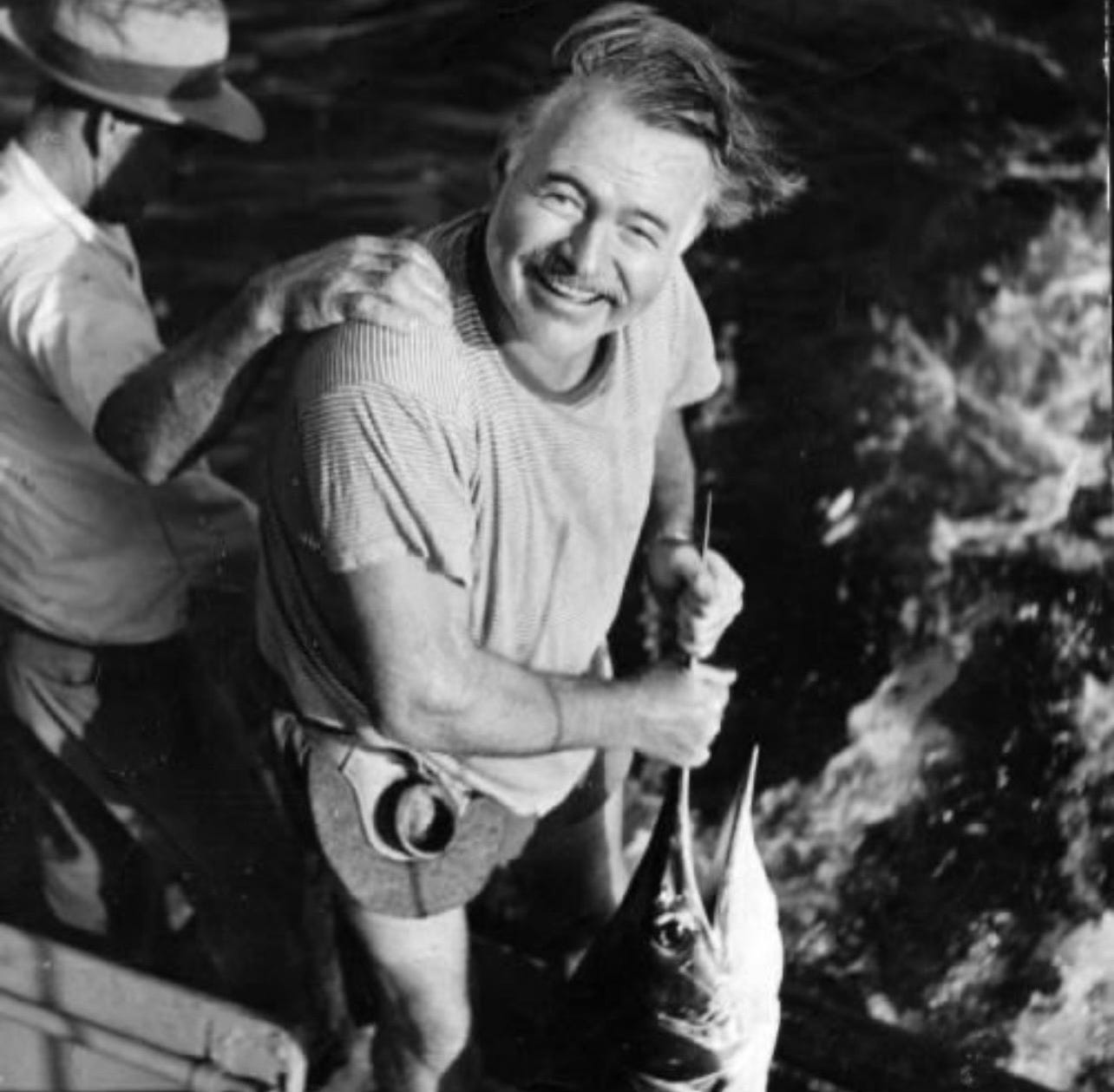
Ernest Hemingway.
In April of 1947, Faulkner was invited to the University of Mississippi where he famously commented on the important writers of the day, after placing himself first in importance. He said of Hemingway— “He has no courage, has never crawled out on a limb. He has never been known to use a word that might cause the reader to check with a dictionary.” In repsonse, Hemingway said of Faulkner— “Poor faulkner. Does he really think big emotions come from big words. He thinks I don’t know the ten-dollar words. I know them all right. But there are older and better and simpler words, and those are the ones I use.” Well, they are both geniuses, so— are they both right, or both wrong? I believe they were both right and wrong, their argument both true and false, and their petty feud much more about pride and slinging mud in an especially heated stretch of their careers than high-flown criticism. These two Alpha males were ultra-competitive and midcentury they were locked in a taut battle for the highest literary awards. Faulkner drew first blood with the Nobel Prize for literature in 1949. Then in 1953 Hemingway won a Pulitzer Prize for “The Old Man and the Sea,”—it was short and terse and brilliant. A year later Papa won his Nobel and surged ahead, finally. But 1955 brought a Pulitzer for Faulkner and his revelatory, highly complex tale of World War 1—and then they were tied. I wish these two titans hadn’t attacked each other, for between them they created the best American literature of their age, and such an ugly, public spat did nothing to elevate either cause—but I shall return to this in a moment.
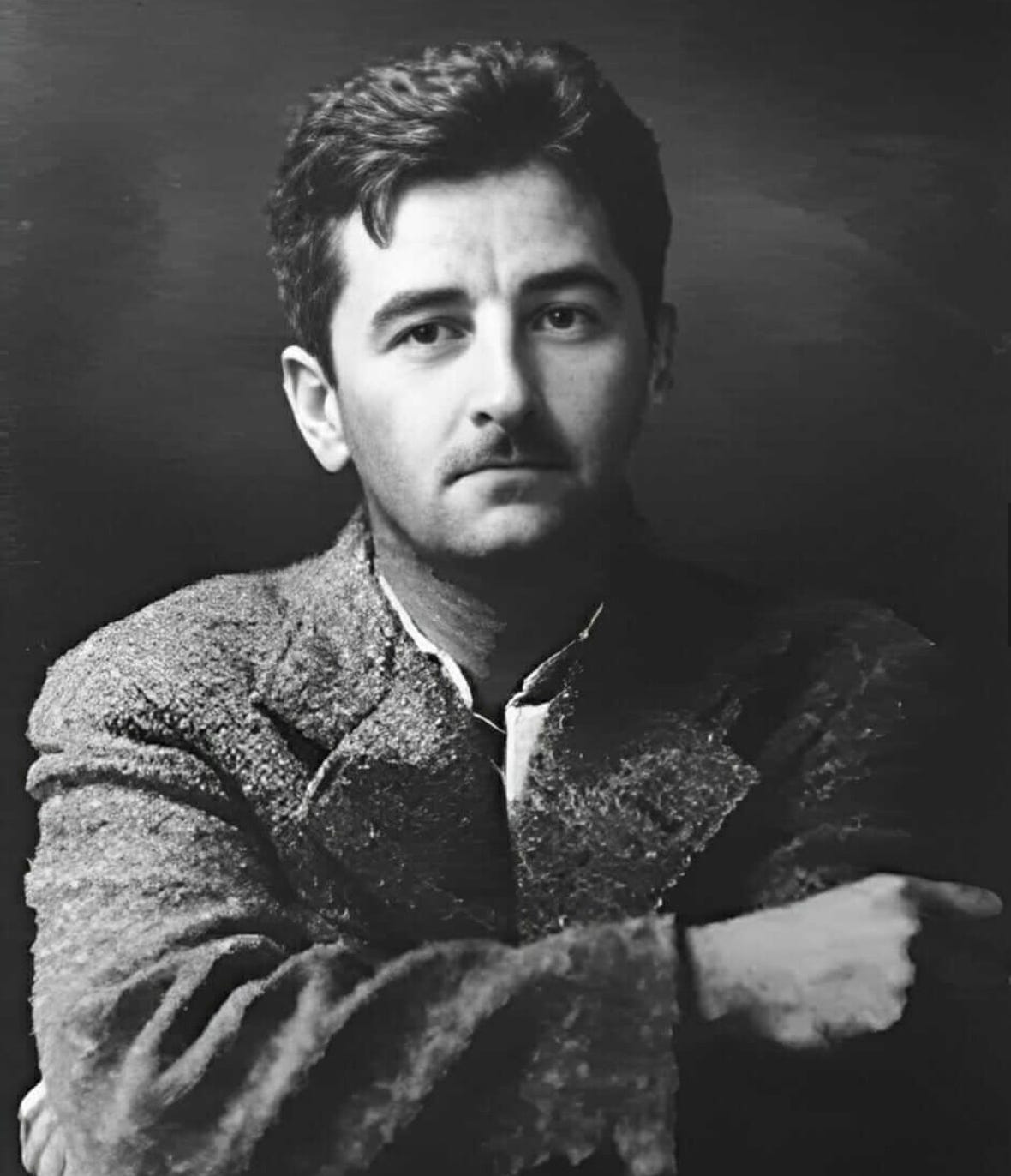
William Faulkner.
The argument of simplicity versus complexity can also be applied in a broader context to the form of a novel. Why read Ulysses, or Swann’s Way, or Moby Dick, or Absalom, Absalom!? These totally unique but difficult novels are all interminable, hard to understand by any normal benchmark, and in total noncompliance with the literary conventions of their day, or any day. For one thing, the sheer artistic courage it took to ignore all the rules is breathtaking; knowing few would appreciate their colossal efforts, and fewer still would understand their meaning. The language of these mighty works can be strange and impenetrable—but also full of buried treasures that can change your perception of life—so that’s another thing. Comparing an ordinary novel to them is pretty much like trying to equate a normal, sober day to an acid trip. I say be open-minded and fearless and take the psychotropic journey. It’s not for the impatient or fainthearted to be sure, but there is a reason they are regarded as masterworks. You’ll be consulting a dictionary for certain, and study guides as well—which is part of the challenge, and the fun, and the education.
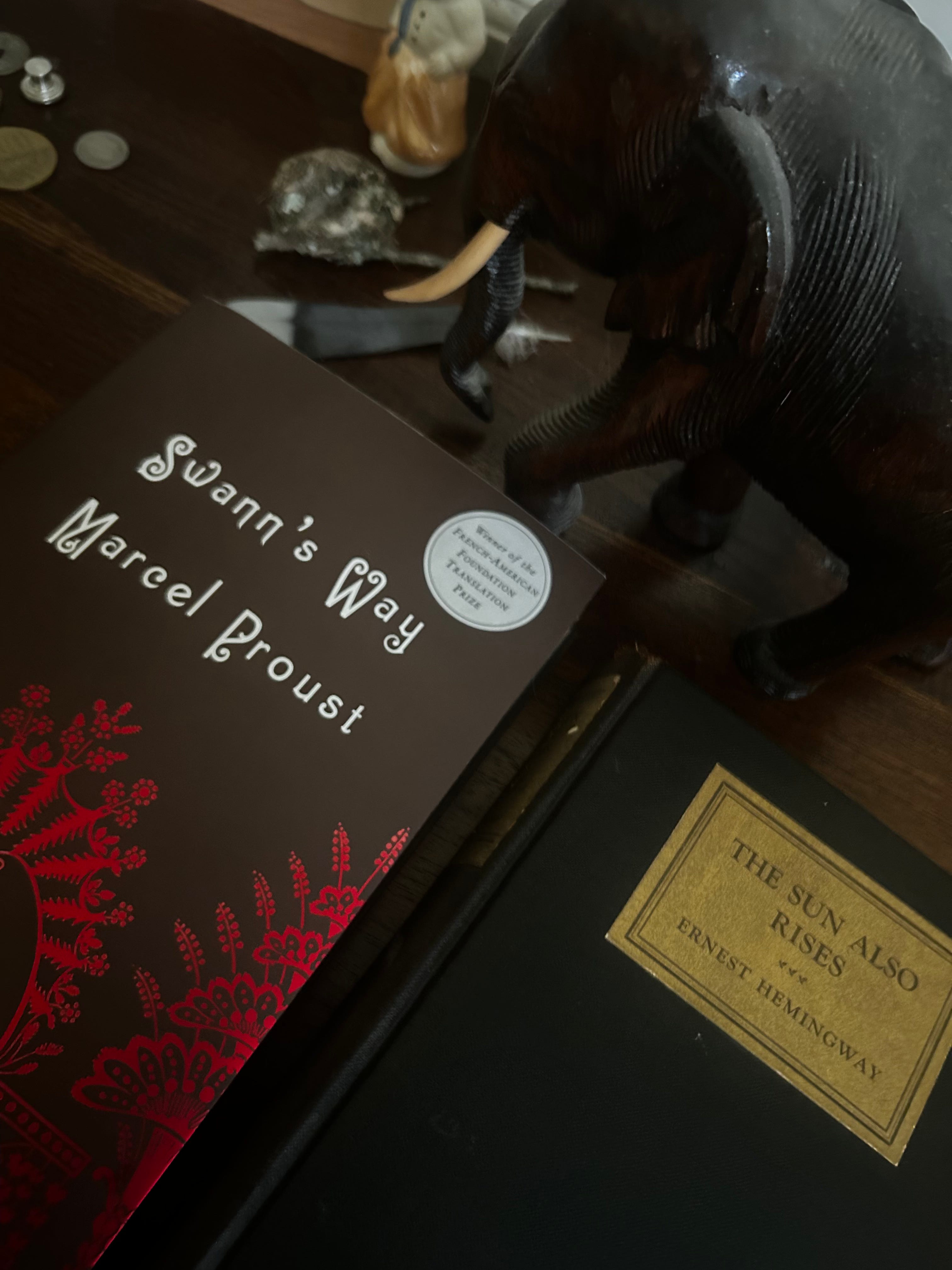
Now here is where the Hemmingway/Faulkner spat gets intriguing. Though Hemingway’s passion for short declarative sentences in his own work is legendary, he also loved and understood the opposite from the beginning. I will offer a few examples that are telling. His admiration for Moby Dick is well-documented; he famously stated that Melville was one of the writers he was “still trying to beat”. He also had great respect for Marcel Proust, and they certainly couldn’t have been more different as writers, or as men (e.g. picture Hemingway, the man’s man, reading and enjoying Swann’s Way—the endless stream of consciousness musings of a delicate mama’s boy). Another startling contrast is provided by James Joyce and Hemingway; collaborative friends early on in Paris, despite their massive stylistic differences. You just don’t get any more complex than Joyce, or more straightforward than Papa Hemmingway—but they got along fine. The two were also occasional drinking buddies—Joyce sometimes needing the burly Hemingway for protection in barroom altercations and Ernest enjoying the Irishman’s unfailing wit and erudition. They inhabited a brave new literary world and thrived in its Promethean air. Paris of the 1920’s was that world’s natural center. A grand place where you could find most of the great rule-breakers of the day—all of them profoundly changing the way stories could be told, the way words could be used, the way conventions could be abandoned wholesale—and each working in their own unique lane. They commiserated and supported each other far more than they feuded. Revolutionaries all with a tremendous esprit de corp. Hemingway’s A Moveable Feast recounts those days with concise honesty. For his part, Faulkner recognized Hemingway’s importance and placed him among the greatest and most important writers of his day…and of course that is entirely the problem.
So, I’m thinking this “feud” between Faulkner and Hemingway wasn’t so much about literary style as settling the prickly matter of relative literary greatness…probably just a silly latter-day American pissing match between titans with no horses but plenty of horseshit.
Well, they were human beings … they both considered themselves to be number one. Both men were known to be emotionally abusive to those closest to them, and in their own inimitable way, these two were very close. It makes sense that they would have a petty, needling rivalry, for both were expert needlers. And both knew who their main rival was. As the contemporary saying goes—they lived rent free in each other’s heads.
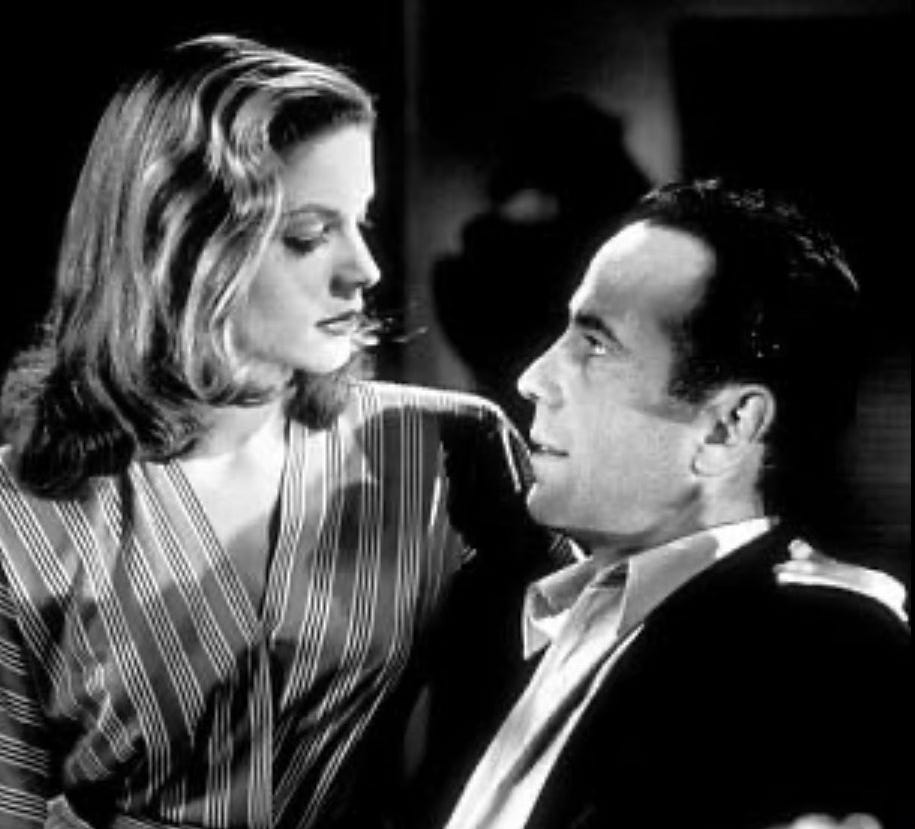
A turning point for whether their rivalry would be friendly, or otherwise, may well have been the 1944 film adaption of Hemingway’s hard-bitten novel To Have and Have Not, the film where Bogey met Bacall and the two fell in love, for real. It has the extraordinary distinction of being the only film worked on by two winners of the Nobel Prize for Literature. It was directed by Howard Hawks, a friend of both Hemingway and Faulkner, and good lord—one can still feel the testosterone surging between these three Alpha males! Hawks had boasted to Hemingway that he could make a great movie of his worst book, which to Hemingway was To Have and Have Not. Personally, I think it’s a great book, not his best but still extraordinary on many levels. It began with an offhand comment, but grew into something big because Papa was game and subsequently—it went into production with Jules Furthman writing the first screenplay. But then something strange and kind of unfathomable happened, Hawks somehow convinced his friend William Faulkner to rewrite the script and Hemingway to let that happen. Predictably, Hemingway was anything but happy with Faulkner’s revisions. The film would be set in Martinique (under the Vichy regime) instead of his beloved Key West, and the plot would lose its Marxist/leftist moorings and become a romantic thriller. The book was partly about love for sure—but it was dark and brutal with uncomfortable politics and a decidedly unresolved and unhappy Hemingwayesque ending. The film was the kind of unlikely and strangely bedfellowed confection that could only be cooked up in the Hollywood of the day. To Have and Have Not is a far cry from the novel, but a fine entertainment nonetheless and it made money—but the critics didn’t like it much, by and large regarding it as an inferior remake of Casablanca. Hemingway hated it.
And the professional needling began…
But who won the trophy contest? Faulkner garnered one more Pulitzer for The Reivers (great book and a horrible movie), two years after Hemingway’s death and shortly before his own—so the pinnacle awards race goes to him—three to two. However, as for who had the greatest impact on the way people would write in the 20th century and on from there—I must give it to Papa Hemingway, with Faulkner, and the need for dictionaries, running a close second. In truth they are twin peaks looking out in all directions. As for their combined impact—I’ll offer a fascinating exhibit A: in one of the most complicated, prominent, and respected writers of our age, Cormac McCarthy, Hemingway and Faulkner are both preeminent and finely distilled. And let’s not forget that Melville’s Moby Dick is also central component of McCarthy’s masterpiece—Blood Meridian—which leans heavily towards Faulkner—or fail to mention The Road, which is pure Hemingway.
Of course, Cormac McCarthy is something else besides, something new. But his bloodline is crystal clear. His wielding of the English language, especially in Blood Meridian, puts him in a class of his own—but you will need a dictionary.
In the final analysis, be the words complex or simple, the form easy or difficult—read on I say, be fearless and unprejudiced, if you dare—especially if the book is one of those “masterworks”. If it is declarative and straightforward, enjoy its simplicity but do not be deceived—it’s true emotional depth is likely to be immense. Try Hemingway’s The Sun Also Rises, For Whom the Bells Toll, or The Old Man and the Sea, the drop is oceanic. And when a definition does not come readily to mind and you must go a-hunting—don’t grumble, there is much to be learned from the hunt. If the writer is a good one—there is a potent reason for that word being used. Try Faulkner’s The Sound and The Fury, Go Down, Moses, or The Bear—the language is brilliant and opulent and more precise than you’ve read. If the form is long and seemingly impenetrable—don’t try and make immediate sense of it—just look for buried treasure and wait for the larger picture to present itself. Read Moby Dick, Swann’s Way, or Ulysses—they are extraordinary, revelatory, beautiful.
The journey will be worth it and the time well-spent. You may also be inclined to curse me for convincing you to take such an extravagant leap, but that’s ok, I believe wholeheartedly in my mission!
As for my own writing ( The Irish Singer), I’ve developed a style that borrows from both the Hemingway and Faulkner traditions; sometimes embracing simplicity, sometimes veering into complexity, and sometimes cutting right down the middle—powerful approaches all and just right for their moment.
Returning to my brother; we were always as different as night and day. Both of us complex, and simple—our wheels frequently spinning in diametrically opposed arcs. Still, when the twain did meet good things could happen, and I will always be grateful for that long ago Christmas gift of the big red Meriam-Webster dictionary and the path it sent me down.
Thank you Eagle and well-played sir!
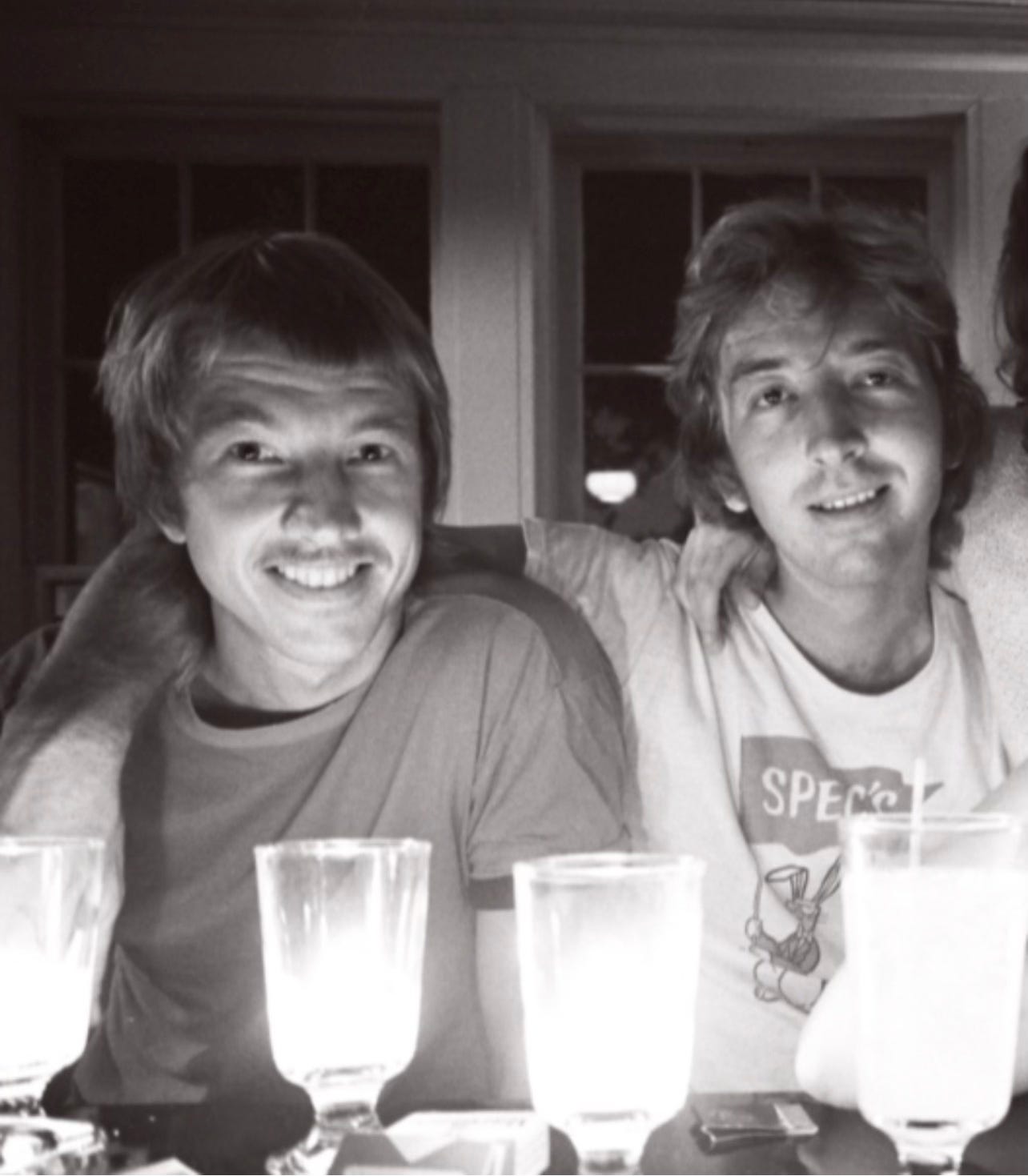
Brother Eagle and I in a Houston bar, 1983.
Reminds me of my own youth when I carried around both a dictionary and a thesaurus. I was pretty obsessed, and I took some ribbing for that! For me, that impulse to know words has been further aided and abetted with the advent of reading on screens. I love the esthetics of a physical book with its more refined typography, but I increasingly find myself reading digitally, mainly because it makes accessing a word’s definition as simple as tapping on it. What might have taken minutes with a book, can now be accomplished in an instant. That ease of use has caused me to look up words far more than I would have in the past. Before, I might have skipped a word I was only mildly curious about. Now I don’t have to hold back. The answer to whether to ‘dictionary’ or not can be rendered moot in the time takes to ask the question.
Chuck, I love the way you connect dictionary use to a discussion of whether it is better to write simply with everyday language or to write with all the complexity and nuance the English language affords. The answer, of course, is yes. Faulkner and Hemingway show us that either approach can produce powerful writing and art. It’s the job of the writer to find his or her own voice, and to use whatever approach most resonates with them. In that journey, I think it’s important to understand there are no wrong approaches, and nothing should start out off the table. The quality of any writing is not the result a particular style, but of the writer’s intention and facility.
Hi, Chuck. Sounds as if Eagle passed you the book that launched your writing career, which I should point out includes your ability to delve into your musical adventures as both a musician, composer, and musical talent scout, as well a recording artist. Add that to filmmaker and your notable book you've authored, and Rene has most of what he'll need much much later when describing you is necessary. You arrived long ago, but you continue to spread your wings, and I await the sequel to your book. BTW, have you read Bud Shrake's book, Blessed McGill? It's one of the best books I've had the ultimate pleasure to read. I did also enjoy his bestseller Custer's Brother's Horse. The Borderland is decent, as well. Suffice to say, I'm happy you're a successful human on this rock and look forward to more success for you on whatever road surfaces you encounter. Now, if we can be fortunate enough to survive this group in power.
Bill McGuire